
Project portfolio management software helps an organization evaluate, prioritize and govern a collection of projects and programs as a portfolio. Its purpose is to connect investment decisions with strategy, expected value, risk, dependencies and limited capacity.
A portfolio view does not replace the management of individual projects. It provides a consistent decision layer above them so leaders can compare proposals, balance commitments and revisit choices when conditions change.
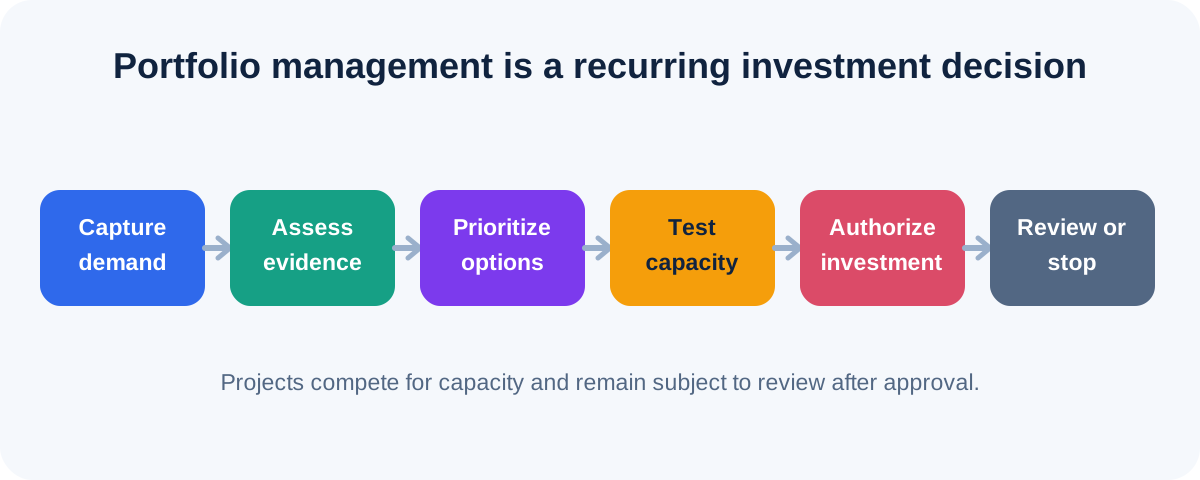
Portfolio management is a decision process
A portfolio is not simply a list of every active project. It is a managed set of investments selected and reviewed together because they compete for resources or contribute to common objectives. Portfolio software should make the assumptions and trade-offs behind those decisions visible.
Core PPM capabilities
| Capability | Purpose | Question to test |
|---|---|---|
| Demand intake | Collect proposals in a comparable form | Can weak assumptions be identified before approval? |
| Scoring and prioritization | Apply transparent decision criteria | Can reviewers see how a ranking was produced? |
| Scenario analysis | Compare possible investment combinations | Can leaders see capacity, risk and value trade-offs? |
| Capacity planning | Compare demand with scarce skills and funds | Does the model use realistic availability? |
| Dependency mapping | Expose relationships among initiatives | What changes when one project moves or stops? |
| Portfolio reporting | Support recurring review and governance | Can decision-makers trace metrics to current project evidence? |
How PPM differs from project management
Project management asks how to deliver a particular outcome. Portfolio management asks which initiatives should receive investment, how the set fits organizational objectives and when a project should be accelerated, changed or stopped. A product may support both levels, but the decisions, data and users are different.
Start with the governance model
Define who can submit demand, who evaluates it, which criteria apply, who approves investment and how frequently the portfolio is reviewed. The software should implement an agreed process rather than become an unexplained scoring machine.
Criteria may include strategic contribution, mandatory obligations, expected benefits, cost, delivery risk, uncertainty and capacity needs. Keep the model understandable. A sophisticated formula does not improve decisions if its inputs are speculative or its weighting is hidden.
Use comparable but honest data
Portfolio comparison requires common definitions for cost, benefit, confidence, status and capacity. It does not require pretending that every proposal is equally certain. Record ranges, assumptions and confidence where appropriate, and distinguish committed facts from forecasts.
Model capacity at the right level
Very detailed resource plans can become expensive to maintain and still misrepresent availability. Begin with the roles, skills, teams or funding pools that actually constrain choices. Use scenarios to test what would need to move when capacity is exceeded.
Review decisions, not only dashboards
A portfolio review should lead to a decision or an explicit continuation. Capture the outcome, rationale, owner and next review trigger. Historical decisions help explain why the current portfolio looks the way it does and improve future estimation.
A neutral example: choosing among three initiatives
Suppose an organization is considering a mandatory control change, a customer-service improvement and an internal automation proposal. A portfolio view records different forms of value, deadlines, uncertainty, dependencies and demand for the same specialist team. The mandatory initiative is not simply given a high numerical score; its constraint and minimum acceptable outcome are visible.
Scenario analysis shows which combination fits available capacity and what is deferred. The decision record captures why one proposal proceeds and what evidence could reopen the choice. This is more informative than ranking everything with a single opaque number.
Measure decision quality and portfolio flow
Useful evidence may include demand awaiting a decision, approved work without credible capacity, benefits without owners, dependencies without treatment and projects continued despite changed assumptions. Completion count is not enough: a portfolio exists to direct resources toward objectives under uncertainty.
Questions for a demonstration
- Compare two scenarios under a scarce-skill constraint.
- Trace a score to its evidence and weighting.
- Stop a project and show the released capacity.
- Record a review decision and its next trigger.
- Separate mandatory commitments from discretionary investment.
Common implementation mistakes
- Buying a PPM platform before agreeing how investments are selected.
- Ranking proposals with precise scores based on weak evidence.
- Counting the same scarce person as fully available to several projects.
- Keeping failed or obsolete initiatives active to protect historical plans.
- Using status color as a substitute for an investment decision.
- Collecting extensive data that no governance meeting uses.
Selection checklist
- Document the current intake, approval and review decisions.
- Define a small authoritative field set and named data owners.
- Test prioritization with disputed real proposals.
- Run at least two constrained-capacity scenarios.
- Confirm traceability from portfolio metrics to project evidence.
- Evaluate permissions, audit history, exports and integration needs.
- Pilot one review cycle before expanding reporting.