
BPM and workflow automation both coordinate repeatable work, but they address different levels of the problem. Workflow automation is usually the better starting point for a bounded sequence of tasks. Business process management is appropriate when the outcome spans processes, teams, rules and systems and needs continuing governance.
The choice is not a contest between “simple” and “advanced” software. It is a scope and operating-model decision. This guide compares the two approaches and provides a practical way to choose.
The short distinction
Workflow automation defines how a case moves through tasks, decisions and hand-offs. BPM manages processes as an interconnected system: establishing outcomes and ownership, modelling and coordinating execution, measuring performance and governing improvement.
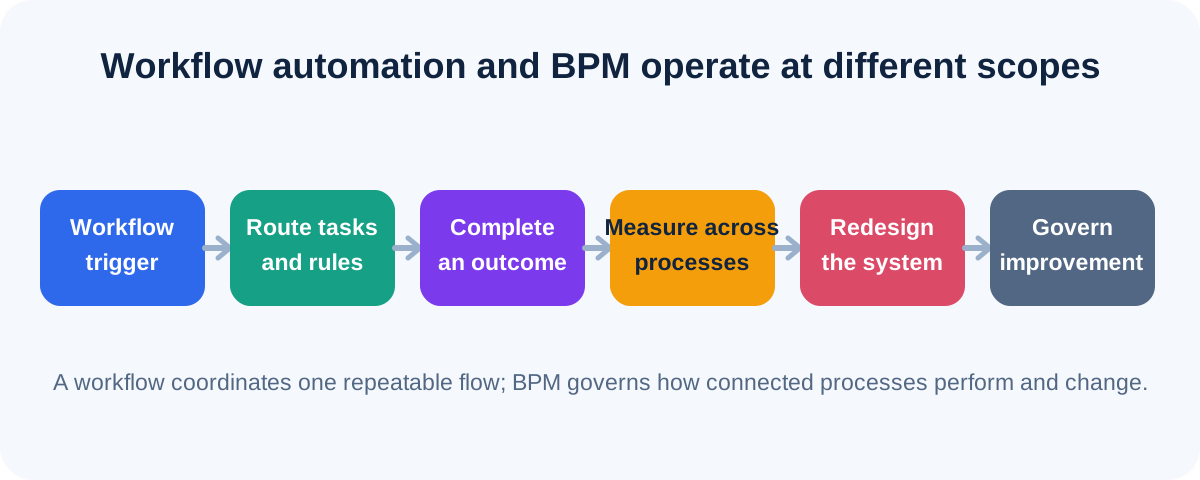
A workflow can exist inside a BPM programme, and many products use both terms. Evaluate the required management scope rather than relying on the label used by a vendor.
BPM and workflow automation compared
| Dimension | Workflow automation | Business process management |
|---|---|---|
| Primary unit | A defined flow of tasks or cases | An end-to-end process and its interactions |
| Typical scope | One team or bounded cross-team sequence | Multiple roles, processes and systems |
| Management focus | Routing, status, rules and completion | Outcome, ownership, architecture, performance and change |
| Modelling depth | Enough to configure and understand the workflow | Process landscape plus detailed models where needed |
| Measures | Workload, time, exceptions and workflow outcomes | End-to-end outcome and process interaction as well as flow |
| Governance | Workflow owner and controlled configuration | Process ownership and coordinated portfolio/change governance |
| Operating effort | Usually narrower | Usually higher because scope and dependencies are broader |
Choose workflow automation when
- the trigger, steps and outcome are reasonably clear;
- the main problem is lost work, inconsistent routing or limited status;
- one owner can manage the flow and its rules;
- integration is limited or well understood;
- the team needs a focused improvement without a process-wide programme.
Examples may include content approval, access requests, invoice review or an internal service request. Important exceptions and controls still need to be designed.
Choose a BPM approach when
- the outcome crosses several processes or departmental boundaries;
- local improvements have shifted delay or risk elsewhere;
- many systems and process variants must be coordinated;
- process ownership, architecture and measures need to be established;
- changes must be governed across an ongoing portfolio of processes.
Examples may include customer onboarding, order-to-cash or a regulated case lifecycle. These examples do not automatically require a large suite; the management approach and software scope should remain proportionate.
Use three tests
1. The boundary test
Can the problem be solved inside one defined workflow, or does the intended outcome depend on how several workflows and systems interact? If improving one flow can damage another part of the outcome, BPM-level analysis may be required.
2. The ownership test
Can one role decide the workflow rules and accept its result? If ownership is fragmented and the outcome has no end-to-end authority, software selection is premature. Establish process ownership first.
3. The change test
Will the team manage one configuration, or a changing set of process models, rules, integrations and measures? Broader change needs justify stronger governance and may justify a BPM platform.
A neutral example
Automating an employee equipment request may require a form, manager approval, assignment and confirmation. That is a bounded workflow. Improving employee onboarding may span contracts, identity, equipment, payroll, training and local exceptions. The wider outcome may need BPM ownership even if each component uses a separate workflow tool.
A hybrid approach is normal
An organization can apply BPM methods to understand and govern an end-to-end process while implementing individual parts with workflow tools, existing applications or manual controls. The architecture should show which system owns data and decisions and how outcomes are measured.
Avoid buying a broad platform only to automate one approval. Also avoid creating many isolated workflows when the real issue is an unmanaged end-to-end process.
What a wrong-sized choice looks like
An oversized approach creates architecture and governance work that the outcome does not justify. Designers may spend more time maintaining a process platform than improving the workflow. An undersized approach creates the opposite problem: separate automations duplicate data and rules, conceal dependencies and make the end-to-end outcome harder to manage.
Reassess the boundary when exceptions multiply, ownership crosses teams or several workflows need the same rules and data. Conversely, reduce scope when a BPM initiative cannot name a measurable outcome beyond “digital transformation.”
Decision checklist
- State the outcome and process boundary.
- Map participants, systems, decisions and important exceptions.
- Identify one accountable owner.
- Establish baseline outcome, quality and flow measures.
- Test whether a policy, form or smaller workflow change is sufficient.
- Estimate the operating effort of the chosen approach.
- Pilot with acceptance measures and a rollback condition.
Continue the evaluation
Read what workflow management software does for the narrower category and what BPM software does for the broader process lifecycle. The BPM readiness guide helps test whether the wider approach is justified.